On the day the new Equality Act 2010: Code of Practice for services, public functions and associations comes into force, the leaders of six London boroughs – including Lambeth – have told the government it “will feel like an attack” on Trans+ (including trans, non-binary and intersex) people in their communities. They have made a joint commitment to ensuring the services they provide for over 1.7million Londoners remain inclusive.
The Equality and Human Rights Commission (EHRC) published the updated code following a Supreme Court judgment last year, ruling that “sex” in the Equality Act 2010 refers to sex assigned at birth.
But leaders of Lambeth, Hackney, Haringey, Lewisham, Southwark and Waltham Forest – boroughs with some of the highest trans and non-binary communities in the country – have demanded the government clarifies that the code must not be used to exclude trans people from services.

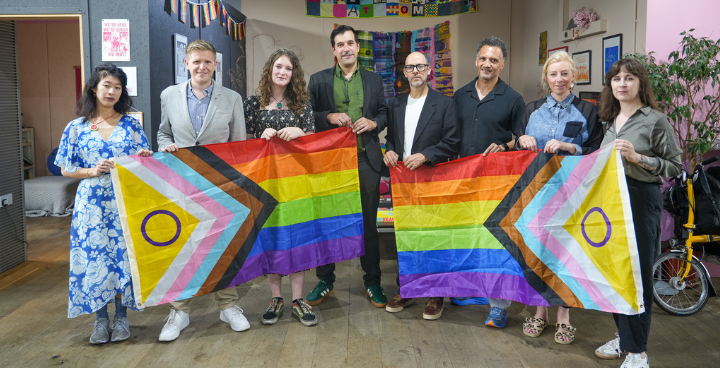
Cllr Kane, Cllr Tam and Cllr Chamberlain of Lambeth, Lewisham and Southwark Councils, at a roundtable marking the joint letter.
They have also warned that council staff should not be placed at risk of “inadvertent discrimination”, where no third spaces are available to Trans+ people. Lambeth Council had already signalled last month that it would resist the new guidance , over fears that it risked “leaving trans people open to discrimination”.
In an open letter to Women and Equalities Minister Bridget Phillipson, the six leaders and other senior councillors said: “We say this to you in no uncertain terms: Trans women are women, trans men are men, and non-binary identities are fundamentally valid.
“It is simply unacceptable that the Code of Practice introduced today is harmful to the rights of trans people and will make their exclusion from public life more likely, not less. This will feel like an attack to the countless trans people in our communities who are simply trying to live their lives in safety and wish to be treated with respect.
“As councils who are proud to be boroughs of sanctuary, with significant LGBTQ+ communities, we are committed to being safe, welcoming and inclusive places for all residents, regardless of their background or identity. We have an unshakeable commitment to ensuring that Trans+ residents can access services safely, with dignity and free from discrimination or harassment.”
Leaders from each council met at the London LGBTQ+ Centre in central London on Wednesday morning, to discuss joint action to protect trans rights and continue to deliver inclusive services.
The councils have underlined their commitment to providing safe, welcoming and inclusive places for all residents, regardless of their background or identity. With all six councils now “reviewing all of our internal practices to ensure that no trans person is excluded on the basis of our actions”.
But, warning that “the government is failing trans people when they need its support the most”, they are calling on Ms Phillipson to:
- Confirm that the EHRC Code of Practice cannot be used to exclude trans people from services – and must be used to create inclusive services for diverse communities
- Introduce legislation which protects the rights of trans and non-binary people, to ensure that “they are able to participate fully in public life and access services safely and with dignity”
- Create an equalities framework that protects trans people’s safety, dignity and humanity.
The letter has been signed by:
- Councillor Martin Abrams, Leader of Lambeth Council
- Councillor Natalie Kane, Deputy Leader and Cabinet Member for Inclusion, Democracy and Culture, Lambeth Council
- Councillor Paul Perkins, Leader, Waltham Forest Council
- Councillor James McAsh, Leader of Southwark Council
- Councillor Victor Chamberlain, Deputy Leader of the Council and Executive Member for Neighbourhoods, Strategic Planning and Wellbeing, Southwark Council
- Zoë Garbett, Mayor of Hackney
- Cllr Mark Blake, Leader of Haringey Council
- Liam Shrivastava, Mayor of Lewisham
It adds: “The government’s own Equalities Impact Assessment acknowledges that there is a real risk Trans+ people could face exclusion, discrimination, or difficulties accessing services if organisations misinterpret the ruling, based on appearance alone. Overly broad enforcement can, and will, lead to trans and non-trans people alike being challenged and excluded from services and facilities.
“Meanwhile, the code introduces a dangerous lack of clarity for us as service providers, leaving our staff at risk of inadvertent discrimination where no third spaces are available to Trans+ people. We won’t put our staff in the impossible position of policing entry to public spaces.
“We stand in solidarity with trans people, an already marginalised community subject to increasing discrimination. This government claims it is standing up for equality. That can never be the case while the rights of trans people are treated as an afterthought.”
Lambeth councillors last month backed a call for the council to refuse to implement the amended code, if the council’s legal team confirms the move would be lawful. A motion to a Full Council meeting condemned the draft code as “incoherent and self-contradictory, discriminatory, and impossible to implement in a reasonable and proportionate manner”. It called on the council to “protect LGBTQIA+ workers and service users” by refusing to implement the guidelines.