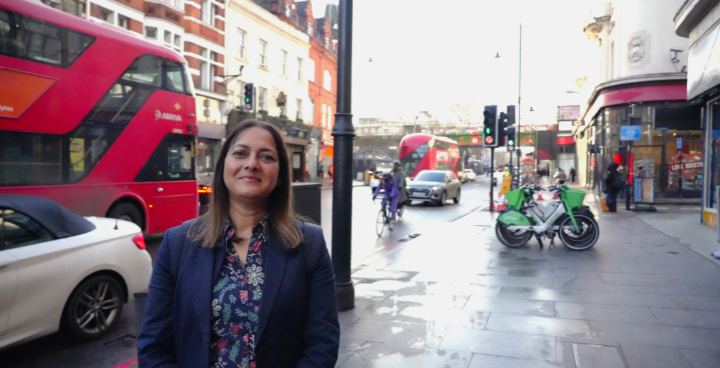
The air quality limit in Brixton Road, which runs through Brixton town centre, was exceeded 883 times in 2015, according to the street’s monitoring station.
But there were zero breaches of the limit recorded in 2024 following concerted efforts to clean up the borough’s polluted air.
The details are contained in Lambeth Council’s new Air Quality Action Plan review, which was considered by the local authorities’ Cabinet on February 2.
Word from Cabinet
Councillor Rezina Chowdhury, Deputy Leader and Cabinet Member for Sustainable Lambeth and Clean Air, said: “This is a huge breakthrough for Lambeth. We have pledged that our children in particular shouldn’t be exposed to toxic air so I’m delighted at this news.
“We’ve worked incredibly hard in alongside our communities, our schools and the Mayor of London to make a difference.
“Our network of healthy neighbourhoods, our groundbreaking kerbside strategy and our ambitious school streets programme have all contributed.
“Toxic air is a public health and climate disaster, leading to 9,400 preventable deaths a year across the country.
“That’s why we’ve taken bold action to clean up Lambeth’s air, and this new plan shows we’re now making vital progress.”
Brixton Road
Data in the Air Quality Action Plan review shows a significant reduction in a range of deadly pollutants in Lambeth, including Nitrogen Dioxide and heavy particulate pollution from traffic, construction, commercial and domestic heating.
Lambeth now complies with UK air quality standards and aims to meet the higher standards set by the World Health Organization.
The significant progress is linked to a range of initiatives at a local, London and national level, including:
- The introduction of more than 45 school streets in Lambeth to tackle congestion outside schools and reduce exposure to toxic air for our young, vulnerable residents.
- Lambeth’s award-winning kerbside strategy has so far seen 2.8km of protected cycle tracks introduced and hundreds of electric vehicle charge points installed
- More than 12,000 trees planted across the borough.
- NO2 concentrations across London are now 27 per cent lower than they would have been following the introduction of the Ultra Low Emission Zone.
- Electrification of the council’s vehicle fleet and equipment – the council now operates several electric bin lorries and is working towards 90% zero-emission machinery in the parks service.
- A new EV strategy has supported the council, residents and businesses’ transition to cleaner transport options, reducing tailpipe emissions and cutting carbon emissions for journeys that still require a car.
Anyone can now track air quality in real time thanks to a borough-wide network of lightweight air quality monitors [Current Lambeth data].
The latest action plan includes a range of measures to continue cleaning up Lambeth’s air. That includes a dedicated member of staff who will monitor pollution from construction sites, ensuring developers don’t breach legal limits.
The council will also be trialling air quality monitoring in some council homes to analyse the effects of retrofit schemes on air quality and to tackle damp and mould. The rollout of new EV charging, bike hangars and support for low-emission freight deliveries are also proposed.
Cllr Chowdhury said: “Families and teachers told us they were sick of choking on toxic fumes at the school gates, which is why we rolled out the UK’s most comprehensive school streets programme, covering the majority of Lambeth primary schools.
“We’re serious about building on the important progress we’ve made, and will continue working with our partners in the community, as well as the Mayor of London and central government to reduce emissions, particularly from transport, construction and gas heating.”
The new plan
The new Air Quality Action Plan (AQAP) replaces the previous action plan, which ran from 2023 to 2025.
It was developed with community stakeholders and focuses on seven key priority areas:
- Monitoring and other core statutory duties
- Borough fleet action
- Cleaner transport
- Delivery, servicing and freight
- Emissions from developments and buildings
- Localised solutions
- Public health and awareness raising
Response at Cabinet
Zak Bond, of the Clean Cities Campaign, told the Cabinet meeting: “Lambeth is widely seen as a borough that is ambitious in cleaning up the air for residents and visitors, and as a place which reaches above the low-hanging fruit towards ambitious action. Your commitments to EV charging and to a car club on every street and estate by 2030 are leading examples for all of London.”
Mr Bond said tackling emissions from vans and lorries was crucial, as they are a major source of air pollution on Lambeth’s roads.
He added, “Therefore, I really welcome everything that’s in the air quality action plan regarding freight and welcome the fact that there is a section on freight in the action plan, which is a great step forward.”
Read the new Air Quality Action Plan and sign up for airTEXT to receive free text or email alerts and help monitor your exposure to air quality across London.